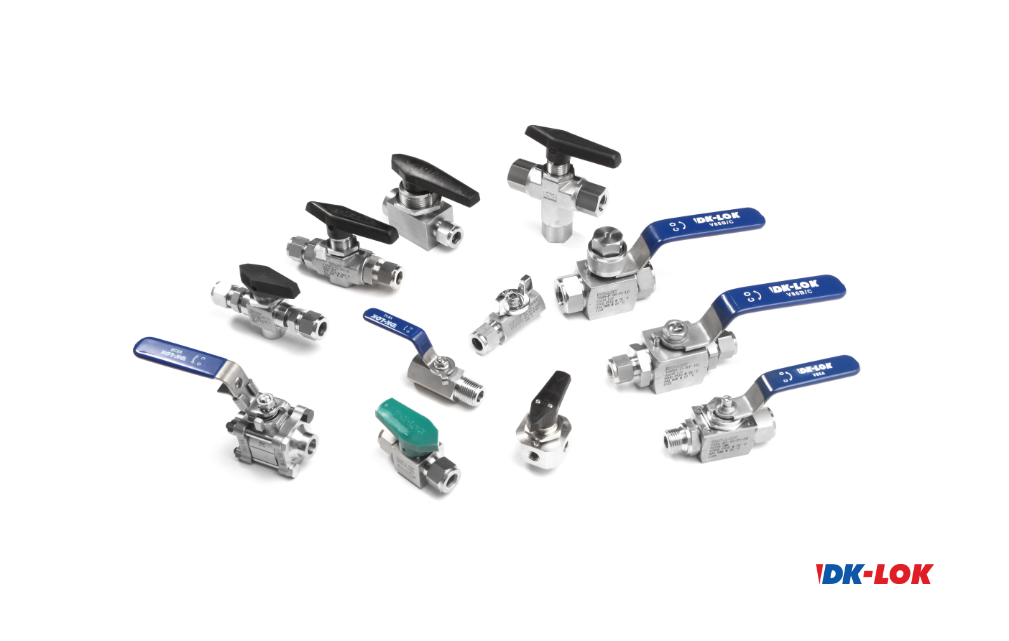
A valve is a device installed in pipelines or pressure vessel to regulate or block the flow of fluids(liquids, gases, steam, etc.)
While fittings connect pipes, valves are responsible for controlling the movement of fluids.
A system cannot function properly if fluids merely flow unchecked. It requires functions such as shut-off, regulation,
backflow prevention, overpressure protection, and directional control. Accordingly, valves are classified into various types,
allowing for the selection of the most suitable valve based on system requirements.
| Shut-off and Flow Regulation
·Ball Valve
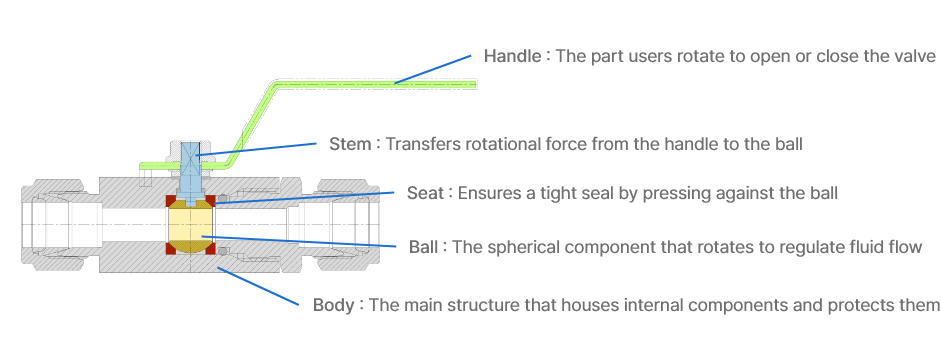
A ball valve regulates fluid flow by rotating a spherical disc (ball) within its body.
The ball has a hole through which fluid passes, and turning the ball either opens or closes the flow path.
By rotating the handle 90°, the valve can be quickly opened or closed, offering excellent operability.
The contact performance between the ball and the seat ensures a high level of sealing. Additionally, the ball’s orifice
matches the inner diameter of the pipe, minimizing flow resistance and pressure loss.
| Low Pressure Ball Valve |
One-Piece Ball Valve |
Swing-Out Ball Valve |
High Pressure Ball Valve |
Trunnion Valve | |
|---|---|---|---|---|---|
| Category |  |
 |
.png) |
.png) |
.png) |
| Model | V81 | V82 | V83 | V86 VC86 |
VT86 |
| Features |
|
|
|
|
|
| Usage | Water, Oil, Gas, Petrochemicals, Instrumentation |
Instrumentation | Chemical, Energy, Pharmaceutical, Biotechnology, Food |
CNG, Hydrogen, Plant | Instrumentation |
2)Ball Orifice : A hole in the ball allowing fluid to pass through.
·Needle Valve
A needle valve features a needle-shaped disc that enables fine control of fluid flow.
Rotating the stem moves the needle gradually into or out of the seat, adjusting the flow path.
Its threaded structure allows for precise flow control, and it offers excellent sealing performance and durability, making it
suitable for high-pressure systems and instrumentation equipment. However, it has a relatively slow operation speed and
may introduce fluid resistance when fully open.
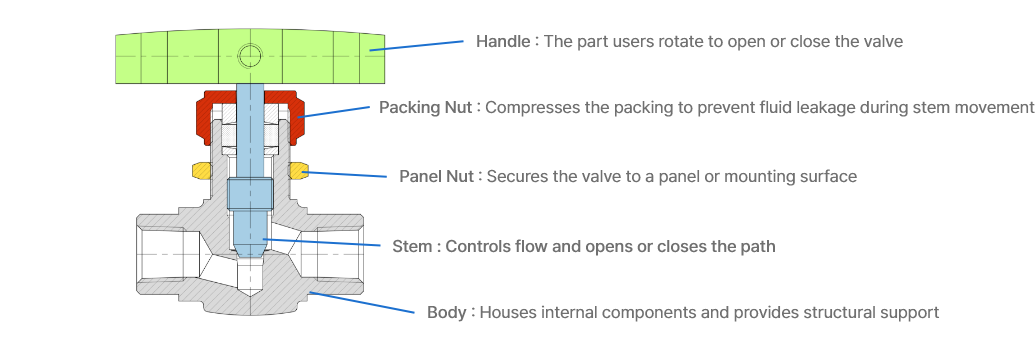
| General Utility | One-Piece Bonnet | Union Bonnet | Cryogenic Valve | |
|---|---|---|---|---|
| Category | .png) |
.png) |
.png) |
.png) |
| Model | VG16 | V15 VB16 |
V16 | VYON |
| Features |
|
|
|
|
| Usage | General Industry, Instrumentation | LNG, LN2(Liquid nitrogen), Shipbuilding, etc. |
||
·Plug Valve
A plug valve controls fluid flow by rotating a cylindrical or tapered plug (disc) within the body.
The flow path is opened or closed as the plug turns.
This valve allows for quick operation with just a 90° rotation, and its simple structure makes maintenance easy.
Various sealing methods (lubricated/non-lubricated) are available, allowing application in diverse industries.
However, friction can increase in high-pressure or high-temperature environments, potentially limiting its use.
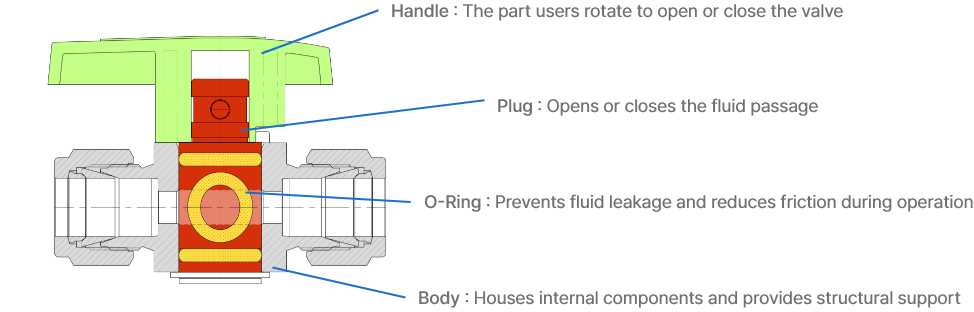
| Category | Model | Features | Usage | |
|---|---|---|---|---|
| Plug Valve | .png) |
V23 |
|
Instrumentation |
Valves are not merely connecting components but play a crucial role in precisely controlling fluid flow and enhancing
the safety and efficiency of systems. Each valve is designed for specific functions and environments, and selecting the
appropriate valve significantly impacts system performance and maintenance costs.
Choosing the right valve for the intended application and operating conditions is essential.